
Listening to the Garden: How a Haikubox Recognizes Birds
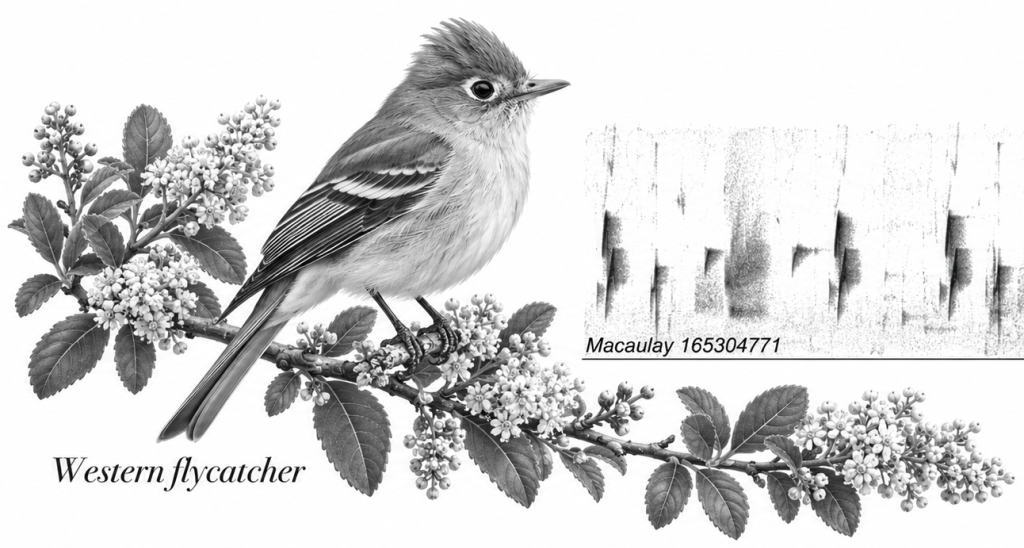
Visitors to the native plant garden at the Lost Coast Nature Center may notice a small electronic box whose job is simply to listen. It is a Haikubox, one example from the rapidly developing field called passive acoustic monitoring. The Haikubox microphones listen around the clock, and if a bird or bat is heard, a sound clip is retained and analyzed.
And how does it do this analysis? Surprisingly, the Haikubox identifies birds and bats by treating sound as something that can be seen!
In 1946 scientists at Bell Laboratories published a pioneering demonstration of a sound spectrograph. They developed an instrument that created images directly from recordings of human voices, snoring, music, random noises–and birds. The images were called spectrograms. They saw very different spectrograms in the small survey of birds that were analyzed, suggesting that birds could be identified on this basis. In fact, Peterson field guides consisting almost entirely of spectrograms have been published for birds of the eastern and western US. Experienced birders could look at the spectrograms and infer what the vocalization would sound like.
Another key part of the Haikubox analysis comes to us in the form of mathematics papers published in 1807 and 1822. In these papers Joseph Fourier described a method for reducing complex patterns into combinations of simple waves. Fourier’s math has many applications today in communications, medical imaging, and much more. In 2004, mathematician Jason Brown used Fourier analysis to investigate the famously mysterious opening chord of the Beatles’ A Hard Day’s Night. He identified the individual notes in the chord, and concluded that the chord included something listeners may have overlooked: notes apparently played on a grand piano by producer George Martin. Similarly the analysis by the Haikubox also is all about sound. Fourier math is used to create a numerical model of the sound recording. The model can be displayed as a spectrogram, but also it is digitally analyzed to make the identification. One needn’t thumb through a field guide full of spectrograms to make the ID!
Fourier supplied the mathematics; Bell Labs made sound visible; and recent advances in computational science provide a way to recognize it. Just as experienced birders learn to identify birds by characteristic patterns in their songs and calls, software can learn to recognize patterns in the digital model of the spectrogram. BirdNET, developed by researchers at the K. Lisa Yang Center for Conservation Bioacoustics at the Cornell Lab of Ornithology and Chemnitz University of Technology, is one of the most successful results.
There are two stages in the use of BirdNET, training and implementation. During training, BirdNET examines a library of bird vocalizations whose species identities are already known. The software makes predictions, compares them to the correct identifications, and repeatedly adjusts its internal mathematic parameters to improve the outcome. In this way the software learns which combinations of acoustic features are useful for distinguishing among species. With training complete and when implemented on devices such as Haikubox or PUC, or the phone app Merlin, BirdNET can analyze a new recording, recognize patterns resembling those it has learned, and arrive at an identification.
There are two important qualifications: BirdNET does not actually hear bird, and an identification is not an observation in the same sense as a person seeing a bird. It detects acoustic patterns resembling patterns it learned during training. Other birds, insects, machinery, wind, rain and assorted accidents of sound can sometimes produce misleading similarities.
That is why people remain an important part of our project.
When the Haikubox app reports an interesting bird in the native plant garden, we can examine when it occurred, listen to the recorded sound, and look at its spectrogram. Knowledgeable local birders can help determine whether the identification makes biological and acoustic sense. The garden’s Haikubox administrator can then provide feedback through the Haikubox app and indicate whether or not an observation is correct. That sound clip and its annotation can then be added to a training set that periodically is used to update BirdNET’s “education”, resulting in more accurate identifications as time goes on.
The detections in the garden will accumulate into something much richer than a species list: a continuous record of when the garden becomes acoustically active, which species occur together, how activity changes through the day and seasons, and what happens when people aren’t there to listen. That will give us plenty to explore in future reports. We can examine the nighttime world of owls and bats, the changing dawn chorus, migrants passing through the Lost Coast, seasonal changes in resident species, and a soundscape representing the relationship between the native plant garden and its surrounding landscape. Once we have accumulated a full year of observations, we can begin displaying some of those patterns graphically.
There is a lot of history and technology packed into that little box in the garden, spanning 250 year old math and the most recent advances in the digital analysis of sound. But the purpose is considerably older and more practically meaningful: to listen carefully to the natural world, and learn who is there.
Submitted by David Duncan
Author’s note:
I am a retired scientist, but not a wildlife biologist. Any mistakes in this article are mine. I welcome insights and comments from people more knowledgeable than I am.
Resources
- Math enthusiasts might enjoy this approachable textbook discussing Fourier math and much more: Steven W. Smith, 1997. The Scientist and Engineer’s Guide to Digital Signal Processing. https://www.dspguide.com/
- Math-enabled musical sleuthing: Jason I. Brown, 2004. Mathematics, Physics and A Hard Day’s Night. CMS Notes 36(6): 4-8. https://www.jasonibrown.com/pdfs/n-oct04-harddayjib.pdf
- The spectrogram field guide to birds of the western US is by Nathan Pieplow, 2019. Peterson Field Guide to Bird Sounds of Western North America. https://academy.allaboutbirds.org/peterson-field-guide-to-bird-sounds/
- Some of the introductory content is posted on Pieplow’s website at https://earbirding.com/blog/specs/visualizing-sound
- Information about BirdNET can be found at https://birdnet.cornell.edu/resources/
- The Haikubox web pages are at https://haikubox.com/pages/our-story
View and listen to the real-time Haikubox action on the Lost Coast Nature Center listening page at https://birds.haikubox.com/listen/E4B063BBB044. Or, better yet, download the free Haikubox 2 app from the Apple App or Google Play Store on your device to access more info about the birds visiting the site and additional tools/resources for greater functionality!